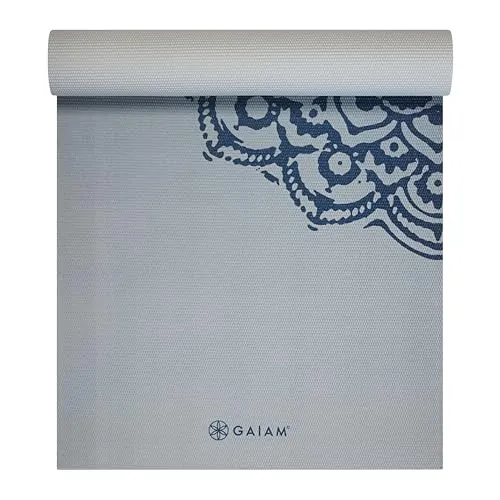
#1 Overall Winner
Gaiam Yoga Mat - Premium 6mm Print Extra Thick Non Slip Exercise & Fitness Mat
- Extra-thick 6 mm PVC construction provides more cushioning for floor-based practice.
Comparison
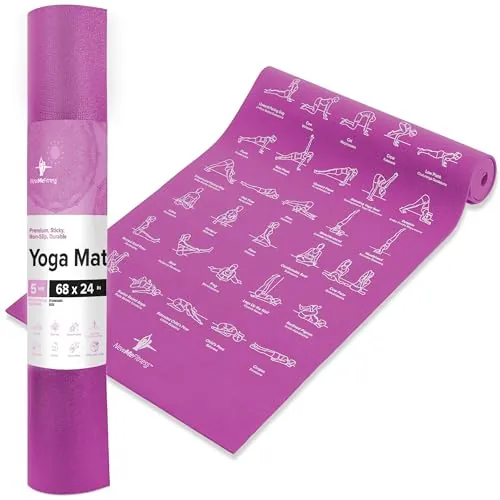
The Gaiam Premium 6mm and NewMe Fitness mats are PVC options for yoga, Pilates, stretching, and home floor workouts. Gaiam prioritizes extra cushioning and lower cost, while NewMe Fitness stands apart with 70 printed pose illustrations for self-guided practice. Both have strong buyer feedback but mixed reports of grip when hands become sweaty. The better choice comes down to whether comfort or on-mat instruction is the higher priority.
#1 Overall Winner
Contender
Choose the Gaiam Premium 6mm mat for better cushioning, lower listed cost, and a more versatile yoga, Pilates, or floor-workout surface. Choose the NewMe Fitness mat if printed pose illustrations would make it easier to start and maintain a self-led practice. Neither mat has consistently strong evidence for grip in very sweaty sessions.
Overall winner
Depends on your needs
| Feature | Gaiam Yoga Mat - Premium 6mm Print Extra Thick Non Slip Exercise & Fitness Mat | NewMe Fitness Yoga Mat with 70 Printed Yoga Poses | Winner |
|---|---|---|---|
Primary use |
Yoga, Pilates, and cushioned floor workouts |
Yoga, stretching, and pose-guided practice |
Depends |
Listed thickness |
6 mm |
5 mm |
Gaiam Yoga Mat - Premium 6mm Print Extra Thick Non Slip Exercise & Fitness Mat |
Dimensions |
68 by 24 inches |
68 by 24 inches |
Tie |
Pose guidance |
Bonus downloadable yoga workout |
70 printed yoga poses |
NewMe Fitness Yoga Mat with 70 Printed Yoga Poses |
Comfort |
Extra-thick cushioning with strongly positive feedback |
Moderate cushioning with mixed thickness feedback |
Gaiam Yoga Mat - Premium 6mm Print Extra Thick Non Slip Exercise & Fitness Mat |
Grip feedback |
Mixed; some slipping reported with sweat |
Mixed; sweaty-hand slipping also reported |
Gaiam Yoga Mat - Premium 6mm Print Extra Thick Non Slip Exercise & Fitness Mat |
Material disclosure |
PVC; free from six named phthalates |
PVC; listed BPA-free and phthalate-free |
Depends |
Portability |
Lightweight and easy to roll according to listing and reviews |
Roll-up design; reviewers describe it as lightweight |
Gaiam Yoga Mat - Premium 6mm Print Extra Thick Non Slip Exercise & Fitness Mat |
Durability feedback |
Generally positive reports of low visible wear |
Positive long-term reports, with print-wear concerns |
Gaiam Yoga Mat - Premium 6mm Print Extra Thick Non Slip Exercise & Fitness Mat |
Cleaning guidance |
Spot clean; dry flat |
Hand wash only |
Gaiam Yoga Mat - Premium 6mm Print Extra Thick Non Slip Exercise & Fitness Mat |
Listed price |
18.26 |
40.45 |
Gaiam Yoga Mat - Premium 6mm Print Extra Thick Non Slip Exercise & Fitness Mat |
Best fit for beginners |
Simple cushioned practice surface |
On-mat pose illustrations for reference |
NewMe Fitness Yoga Mat with 70 Printed Yoga Poses |
Gaiam is the stronger choice for gentle post-workout stretching and floor-based mobility because reviewers more consistently praise its cushioning. NewMe Fitness is useful for a person who wants a visible menu of stretches and yoga positions while cooling down. These are comfort and routine-support differences, not evidence that either mat directly changes recovery outcomes. On hard floors, users who spend substantial time kneeling or lying down may prefer Gaiam’s additional stated thickness.
For broad training use, Gaiam is the more flexible mat because its extra thickness is better aligned with floor-based mobility, Pilates, abdominal work, and kneeling positions as well as yoga. NewMe Fitness is more purpose-built for self-guided yoga and stretching: the printed poses can reduce the friction of choosing a movement sequence. Both share the same length and width, so neither offers more physical practice area. Users who already know their poses are likely to gain more from Gaiam’s added cushioning, while newer users may find NewMe’s visual layout more useful for maintaining a simple routine.
Neither product is a load-bearing strength-training tool, but both can provide a more comfortable surface for bodyweight work, warm-ups, core exercises, and mobility between lifting sessions. Gaiam is the better supporting option because its 6 mm construction has stronger cushioning feedback for knees and back contact. NewMe Fitness can work for guided stretching around a strength routine, but its printed poses are more relevant to yoga practice than progressive resistance training. For weighted kneeling exercises, users should consider whether the mat provides sufficient protection for their floor and comfort needs.
Both mats are highly relevant to mobility and flexibility work. Gaiam is better suited to longer floor-based sessions where knee cushioning and a comfortable surface matter most. NewMe Fitness offers an advantage for people learning a basic flexibility routine because the pose illustrations provide visible prompts for selecting and recalling positions. The printed imagery should be treated as a reference rather than personalized coaching. In either case, reports of reduced grip with sweaty hands mean users should take extra care during weight-bearing transitions or choose a setup appropriate to their sweat level.
For non-medical recovery routines such as gentle stretching, relaxed mobility, and cooldown work, both mats provide a defined, portable floor surface. Gaiam’s thicker build makes it the more comfortable option for seated, kneeling, or supine positions on harder flooring. NewMe Fitness can be useful when a person wants visual reminders for a simple stretching sequence. Neither mat itself is evidence of improved recovery outcomes; their role is to support a more comfortable and organized movement routine.
Both mats appear capable of their intended role as yoga and general exercise surfaces, but their performance strengths differ. Gaiam’s 6 mm thickness, textured surface, and consistently favorable comfort feedback make it the stronger general-purpose option for stable, cushioned floor practice. NewMe Fitness performs best as a practice aid: its printed pose library is a practical feature for users who want an at-a-glance reference. Grip is the key uncertainty for both. Several supplied reviews praise traction, yet others describe slipping when sweat accumulates, so neither should be assumed to perform equally well in hot or high-sweat yoga.
NewMe Fitness has a notable training-support feature in its 70 printed pose illustrations. For a beginner building a home yoga habit, seeing pose options on the mat can make a self-directed session easier to begin and continue. Gaiam supports consistency differently: its comfortable, lightweight, easy-to-roll format is well suited to repeated use across yoga, stretching, Pilates, and floor workouts. For advanced users who already know their sequences, Gaiam’s more cushioned surface is likely more valuable than printed prompts. For newer users, NewMe’s images may lower the barrier to practicing independently.
For strength-adjacent exercise, Gaiam has the advantage as a comfort layer for bodyweight circuits, core work, glute exercises, and mobility. Its added thickness is more useful where knees, hips, or back contact the floor. NewMe Fitness is adequate for these roles but its main added feature does not improve load progression, resistance, or exercise stability. Neither product replaces a stable lifting surface or protective flooring for heavy equipment. Users should also account for the 24-inch width when planning planks, push-ups, and wider hand positions.
Gaiam and NewMe Fitness are both well matched to flexibility sessions, but they offer different forms of support. Gaiam’s cushioning is more useful for sustained kneeling, seated folds, and floor mobility on firm surfaces. NewMe Fitness gives beginners a practical visual index of yoga poses, which may help with session structure and pose recall. Its thinner profile may feel more grounded for balance work, although feedback on comfort is less consistent. For either mat, a towel or other adjustment may be useful if palms become slippery during a sweaty practice.
Gaiam is the stronger choice for gentle post-workout stretching and floor-based mobility because reviewers more consistently praise its cushioning. NewMe Fitness is useful for a person who wants a visible menu of stretches and yoga positions while cooling down. These are comfort and routine-support differences, not evidence that either mat directly changes recovery outcomes. On hard floors, users who spend substantial time kneeling or lying down may prefer Gaiam’s additional stated thickness.
Both mats are intended to provide a more comfortable exercise surface, but safe use still depends on the activity, the floor, and the user’s traction. Gaiam has stronger evidence for stable, cushioned floor practice, while NewMe’s grip feedback is more variable. Reviews for both identify slippery hands when sweat is present, which matters during weight-bearing poses such as planks. NewMe’s printed diagrams are useful references but cannot assess form or individual limitations. Gaiam lists six phthalates it is free from, while NewMe lists BPA-free and phthalate-free PVC; these are manufacturer-provided material statements.
Gaiam is the clearer comfort winner. Its 6 mm thickness is supported by repeated buyer comments about cushioning for knees, joints, back contact, and hard floors, while remaining manageable for balance work. NewMe Fitness provides some padding and several buyers consider it comfortable, but others find it too thin or less comfortable for longer holds on firm surfaces. If kneeling, floor Pilates, or restorative positions are regular parts of the routine, Gaiam’s additional cushioning is the more practical advantage.
Both mats are straightforward roll-out exercise surfaces, but NewMe Fitness has a small ease-of-use advantage for beginners because the pose illustrations are immediately visible during a session. This can reduce the need to pause a video or search for a familiar pose. Gaiam is also easy to use day to day, with lightweight portability and more detailed cleaning instructions. The Gaiam mat may need an initial airing period due to reported odor, while NewMe users should account for its hand-wash-only care guidance.
Gaiam is the stronger stability choice based on its thicker cushioned construction and more favorable reports of staying in place during practice. NewMe Fitness can provide a firm base for standard poses, but its stability evidence is less consistent and some reviewers describe slickness in certain conditions. Neither product is immune to changing traction when wet. For plank, downward dog, or balance-oriented sessions, users should test the mat on their own flooring before relying on it for demanding transitions.
Gaiam has the better overall grip case, with a textured sticky surface and many positive reports of traction. However, it is not a definitive hot-yoga solution: supplied reviews also mention hands slipping when sweat accumulates. NewMe Fitness likewise receives mixed feedback, ranging from non-slip reports to sweaty-hand slickness. The NewMe listing’s moisture-wicking description is a product claim, while the mixed review evidence suggests results vary by user and conditions.
Both products are space-efficient because they share a 68 by 24 inch footprint and can be rolled up after use. Gaiam has the slight advantage for compact home setups because reviews more consistently describe it as lightweight and easy to move or store. NewMe Fitness also rolls into a neat format according to reviews, though its printed surface may make it more likely that owners want to store it carefully to protect the visual guides. Neither mat is a large fixed piece of home-gym equipment.
Both mats are quiet training accessories. They can reduce direct body-to-floor contact during yoga, stretching, Pilates, and bodyweight work, but neither listing makes a specific sound-reduction claim. Noise in use will depend more on the exercise, flooring, footwear, and surrounding equipment than on the difference between these two mats.
Both products are PVC roll-up mats with generally favorable quality feedback. Gaiam has the stronger build-quality case because its reviews more consistently describe a sturdy, well-finished mat that remains easy to roll and does not readily move across the floor. NewMe Fitness also has favorable reports, including long-term use, but the illustrated top surface introduces an additional possible wear point. Neither supplied listing provides detailed information about backing construction, surface coating, or manufacturing process, so build comparisons should remain limited to the stated material and buyer reports.
Gaiam has a modest durability edge in the supplied evidence. Several reviewers report little visible wear after regular use, although long-term durability will vary with care, floor type, and practice style. Its care instructions specifically warn that extended sun exposure may cause fading and brittleness. NewMe Fitness has positive reports from users who have used it for years, but there are also concerns about possible fading of the printed poses. Both should be cleaned and stored as directed to help preserve the PVC surface and print finish.
Gaiam provides the more complete maintenance guidance: spot clean with a dedicated mat wash or a damp cloth with cold water and mild detergent, dry flat, avoid extended sunlight, and consider a mat bag for storage. It also recommends airing out the mat for two to three days after unwrapping. NewMe Fitness lists hand wash only, which is clear but less detailed. For both, careful cleaning and storage are especially relevant because each uses a printed PVC surface.
Gaiam has a portability advantage. At a listed weight of 1.39 kilograms, it is described as lightweight and easy to roll, move around the house, or bring to class. NewMe Fitness is also a roll-up 68 by 24 inch mat, and reviewers describe it as manageable to transport, but no product weight is supplied. Neither listing indicates that a carry strap is included, so buyers who travel to classes may need one separately.
Material information is reasonably clear for both mats, although neither listing supplies a complete manufacturing breakdown. Gaiam identifies the material as PVC and specifically states that it is free from DEHP, DBP, BBP, DINP, DIDP, and DNOP. NewMe Fitness also identifies PVC and states that it is BPA-free and phthalate-free. These are listing disclosures rather than independent verification. Buyers with specific material preferences should rely on the manufacturer information and consider contacting the brand if they need details beyond the supplied descriptions.
Gaiam offers better value on the supplied information. Its listed price is substantially lower, yet it provides a slightly thicker surface, strong comfort feedback, clear material disclosure, and a large volume of favorable reviews. NewMe Fitness costs more but offers a distinct non-material feature: 70 printed pose illustrations. That premium is most defensible for beginners who will use the images regularly to structure independent practice. Buyers who already follow an instructor, app, or established sequence are less likely to benefit from the added cost and may find Gaiam the more efficient purchase.
Gaiam has the stronger trust case in this comparison, supported by a much larger supplied review count, consistently positive buyer sentiment, and relatively specific material and care disclosures. NewMe Fitness also has a large and favorable body of reviews, particularly around beginner usefulness and pose guidance, but its evidence base is smaller and its listing provides less detailed care information. Review volume and listings are useful purchase signals, not independent proof of long-term product performance or material claims.
Both mats have the same strong listed star rating and many positive reviews. Gaiam’s much larger review sample repeatedly highlights cushioning, patterns, lightweight handling, and perceived durability. Its recurring negatives are odor and inconsistent traction when damp. NewMe Fitness buyers frequently praise the printed poses, beginner usefulness, and long-term utility; however, its reviews more often raise concerns about thinness, wet-hand grip, odor, and eventual print wear. Overall sentiment is favorable for both, with Gaiam showing the more consistent all-purpose satisfaction pattern.
The core functional claims are partly supported by product specifications and buyer experience, but should be read with appropriate caution. Gaiam’s dimensions, PVC material, specified phthalate exclusions, and care instructions are clearly stated; reviews broadly support its cushioning, while wet-grip experiences are inconsistent. NewMe Fitness clearly states its dimensions, material, 5 mm thickness, and 70 printed poses, and reviews support the usefulness of those illustrations for beginners. Its moisture-wicking and non-slip positioning is less consistently reflected in sweaty-hand feedback. Neither mat’s listing or reviews should be treated as proof of individualized alignment, safety, or health outcomes.
The Gaiam Premium 6mm mat wins this comparison as the better all-purpose exercise mat. Its main strengths are greater stated thickness, stronger comfort and portability feedback, clear care guidance, and a lower listed price. Its main limitations are a possible initial odor and variable grip when hands are sweaty.
The NewMe Fitness mat does not match Gaiam as a general value or cushioning choice, but it has one meaningful advantage: 70 printed pose illustrations that can support beginner-led yoga and stretching sessions. Its thinner build, higher listed price, and less consistent grip and comfort feedback make it more of a niche option. Choose Gaiam for versatile floor training; choose NewMe Fitness when visual pose guidance is worth the trade-off.
Overall winner
Depends on your needs
The Gaiam is the stronger all-round choice for buyers who prioritize cushioning, portability, and lower upfront cost. The NewMe Fitness mat is the more specialized choice for beginners who will genuinely use its printed pose illustrations. Both have positive buyer feedback, but both also receive mixed reports about grip when hands are sweaty.
The NewMe Fitness mat has a clear beginner-focused advantage because it displays 70 pose illustrations on the surface. These can provide quick visual reminders during a self-led session. They are not a substitute for instruction or individual technique feedback, so people learning unfamiliar poses should still progress carefully or seek qualified guidance.
The Gaiam mat is listed at 6 mm thick, compared with 5 mm for the NewMe Fitness mat. That modest difference supports its stronger comfort feedback for knees and other floor-contact positions. Cushioning preferences remain personal: a firmer surface can feel more stable for some balance-focused practice.
Yes. Both listings position the mats for yoga, Pilates, stretching, and general floor exercise. The Gaiam mat is particularly well suited to users wanting extra cushioning for abdominal, glute, or kneeling work. The NewMe mat can also support these sessions, although some reviewers wanted more thickness on hard flooring.
Neither mat has unequivocal buyer feedback for sweaty practice. Both products are described as non-slip, yet supplied reviews include reports of hands becoming slippery when wet. The NewMe listing describes its PVC as having moisture-wicking properties, but that listing statement should not be treated as a guarantee of grip in every hot or high-sweat session.
The Gaiam offers the stronger value case from the supplied information: it has a lower listed price, slightly greater thickness, broad positive feedback, and strong comfort evidence. The NewMe mat costs more, but its pose illustrations may justify that difference for a beginner who uses them regularly rather than relying on videos or a class.
Both products identify PVC as the mat material. Gaiam additionally states that its mat is free from DEHP, DBP, BBP, DINP, DIDP, and DNOP. NewMe Fitness states that its PVC is BPA-free and phthalate-free. Neither supplied listing provides a full discussion of every manufacturing component or coating.
Gaiam recommends spot cleaning with a yoga-mat wash or a damp cloth with cold water and mild detergent, then drying flat. It also advises avoiding extended sun exposure and storing the mat in a bag. NewMe Fitness lists hand wash only. Follow the relevant product guidance, especially to preserve the printed surface.
Check our rankings and expert guides to find the best fitness products for your goals.